
Earthquake Risk to Power Grids: Mitigation & Monitoring Opportunities

As the population of the North American West continues to grow, so too does the need for dependable and resilient power. As utilities invest in grid expansion, modernization, and hardening, it’s vital to consider the impacts of natural hazards. While wildfires, windstorms, and atmospheric rivers make headlines, earthquakes remain a persistent threat capable of bringing entire cities to their knees without notice.
This was the theme for the Western Energy Institute’s engaging March webinar for members and the broader energy sector, Earthquake Risk to Power Grids, delivered by Safehub’ licensed engineers Sean McGowan, PE (Safehub Technical Solutions Manager) and Evan Reis, SE (Safehub Executive VP and Director for Science & Analytics).
Laying the Foundation
Safehub set the stage for a diverse webinar audience, laying out the basics of earthquake risk for the west coast of the US and Canada, along the Rockies, and in between – as well as Alaska and Hawaii. Population growth is already pushing the grid to its limits in many of these areas, and the threat of earthquake damage compounds this risk.
Building upon this context, Safehub addressed three particularly critical earthquake vulnerabilities in the energy sector:
- Toppling of transformers
- Gas line/connection rupture
- Structural deficiencies in utility buildings
Drawing from his Federal career with the US Geological Survey and the Federal Emergency Management Agency, Sean McGowan, PE noted that ”transformers are perhaps the weakest link – they’re heavy, brittle, and precisely calibrated – the achilles heel of the grid from an earthquake resilience perspective”. Gas lines – often brittle iron pipes – cross the often unavoidable faults throughout the West. Fault movement as well as shifts in building position relative to the ground can cause infamously inflexible gas lines to rupture. Furthermore, McGowan emphasized that buildings constructed prior to ~2000 often have known earthquake vulnerabilities – putting Emergency Operations Centers, line truck facilities, power generation plants, service centers, and administrative offices at risk of damage in these older buildings.
Out of the Pan [Assembly], Into the Fire
Safehub then emphasized the importance of thinking holistically about natural hazards, rather than addressing them in isolation. The second portion of the webinar explored the dual disaster of fires triggered by earthquake damage to electric and gas equipment. From San Fernando (1971), Loma Prieta (1989), Northridge (1994), to Tohoku (2011), and South Napa (2014), these conflagrations compound losses and complicate the immediate disaster response and reenergization of the power grid.
While these examples seem like dramatic black swan events on the surface, Safehub referenced the Camp Fire which killed 85 people and was ignited by a single broken 3-inch metal hook on a transmission tower. Recognizing that earthquakes can cause significantly more severe impacts to transmission infrastructure, attendees were reminded that “earthquake risk is fire risk”.
An Ounce of Prevention
Risk awareness is critical, but putting the information into action is what really matters. As emergency management undergoes systemic changes in scope at the local, state, and national levels, it’s increasingly important that energy utilities are prepared internally to tackle the risks they face – external help may not be available after an earthquake.
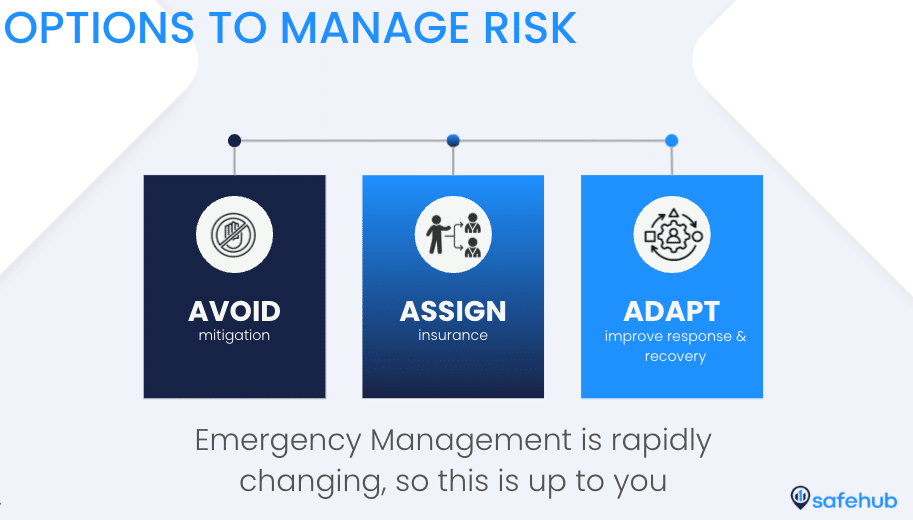
Safehub laid out three primary ways a utility can reduce its earthquake risk:
- AVOID – MITIGATION
- ASSIGN – INSURANCE
- ADAPT – IMPROVE RESPONSE & RECOVERY
Bonneville Power Administration and Seattle City Light, highlighted as examples of Pacific Northwest utilities avoiding earthquake risk to energy infrastructure, have innovatively begun mitigating their transformers using a technique called base isolation. This approach involves insertion of a number of base isolators – devices that support the transformer weight while safely dissipating side-to-side earthquake motion – under each transformer to protect it from shaking damage. Assigning earthquake risk can be addressed through a number of indemnity and parametric earthquake insurance solutions; this is a detailed topic to be addressed during a future webinar.
The remainder of the webinar dug into adaptation to earthquake risk by improving utility response and recovery capabilities. One option is to pursue staff training through the Safety Assessment Program, which helps portfolio owners quickly assess damage to, and triage, their assets. Due to the recurrence of aftershocks following large earthquakes, attendees are reminded that even this expedited procedure can prove daunting for a large and distributed network of assets such as a power grid when the inspections must be repeated.
Grid Digitalization for Utility Resilience
To understand earthquake impacts at a regional scale, utilities can turn to resources such as USGS ShakeMap. However, for infrastructure as sensitive and critical as the power grid, this serves as a less-than-ideal resource for prioritizing response at the level of individual assets.. Drawing from his leadership experience at top structural engineering firms and as the Executive Director of the US Resiliency Council, Evan Reis described how “soil variations and other variables can cause identical buildings even across the street from each other to experience notably different shaking levels.” Therefore, utilities need a way to quickly assess damage site by site. And while wired sensors have a long track record, they are challenging to install and expensive to purchase and operate – especially for portfolios as expansive as those in the energy sector.
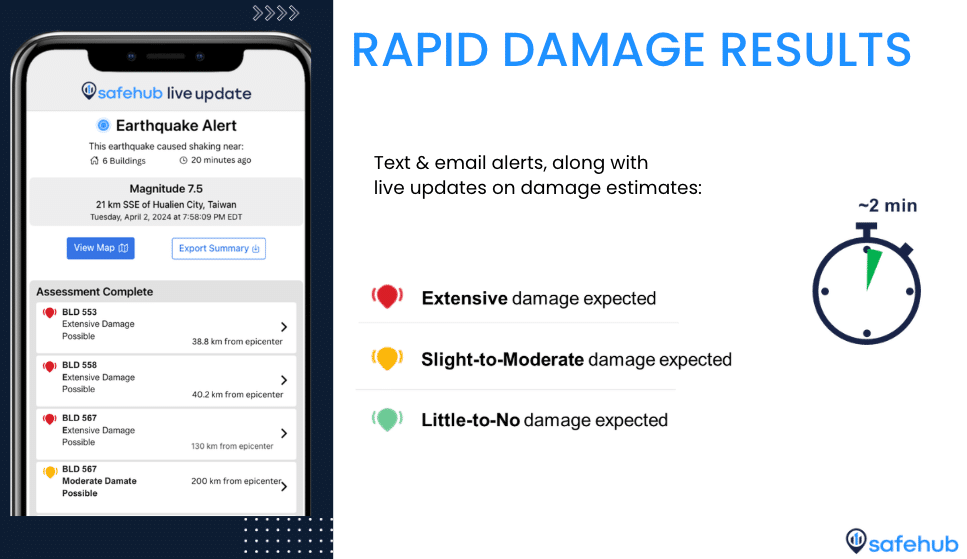
Today, it is possible to monitor hundreds of widely distributed facilities using wireless site-specific earthquake sensors and grid digitalization technology for a fraction of the cost of traditional sensors. Reis noted that these more nimble wireless sensors “don’t require a PhD to install – just a screwdriver”. They empower utility operators to access accurate, site-specific shaking information at their facilities without reliance on more generalized regional maps. Safehub’s industry-leading sensors produce shaking values that can be compared against custom-assigned asset fragilities, resulting in high-confidence damage estimates for hundreds of facilities within a few minutes of an earthquake. These damage estimates can also be directly ingested into Emergency Operations Center frameworks for data-driven decisions in a high-stakes environment of uncertainty. With this technology, utilities can leverage asset-specific insights to more rapidly deploy field inspectors and repair crews, accelerating re-energization of the grid based on measured conditions rather than assumptions. This approach to earthquake grid digitalization is designed to enhance grid protection while reducing operational downtime and liability.
As hazards such as atmospheric rivers and wildfires lay siege to the energy sector, Safehub notes that we can’t lose sight of the fact that earthquakes are no-notice events capable of unleashing cascading disasters at the city and regional scales. Earthquakes “don’t give us the benefit of Watches, Warnings, and Cones of Uncertainty”. Thankfully, grid digitalization is the future of energy resilience, and affordable, scalable earthquake monitoring and alerting is the bridge between earthquake risk reduction and grid reliability.