
Post-Earthquake Inspections: Who Should Decide if a Building is Safe?
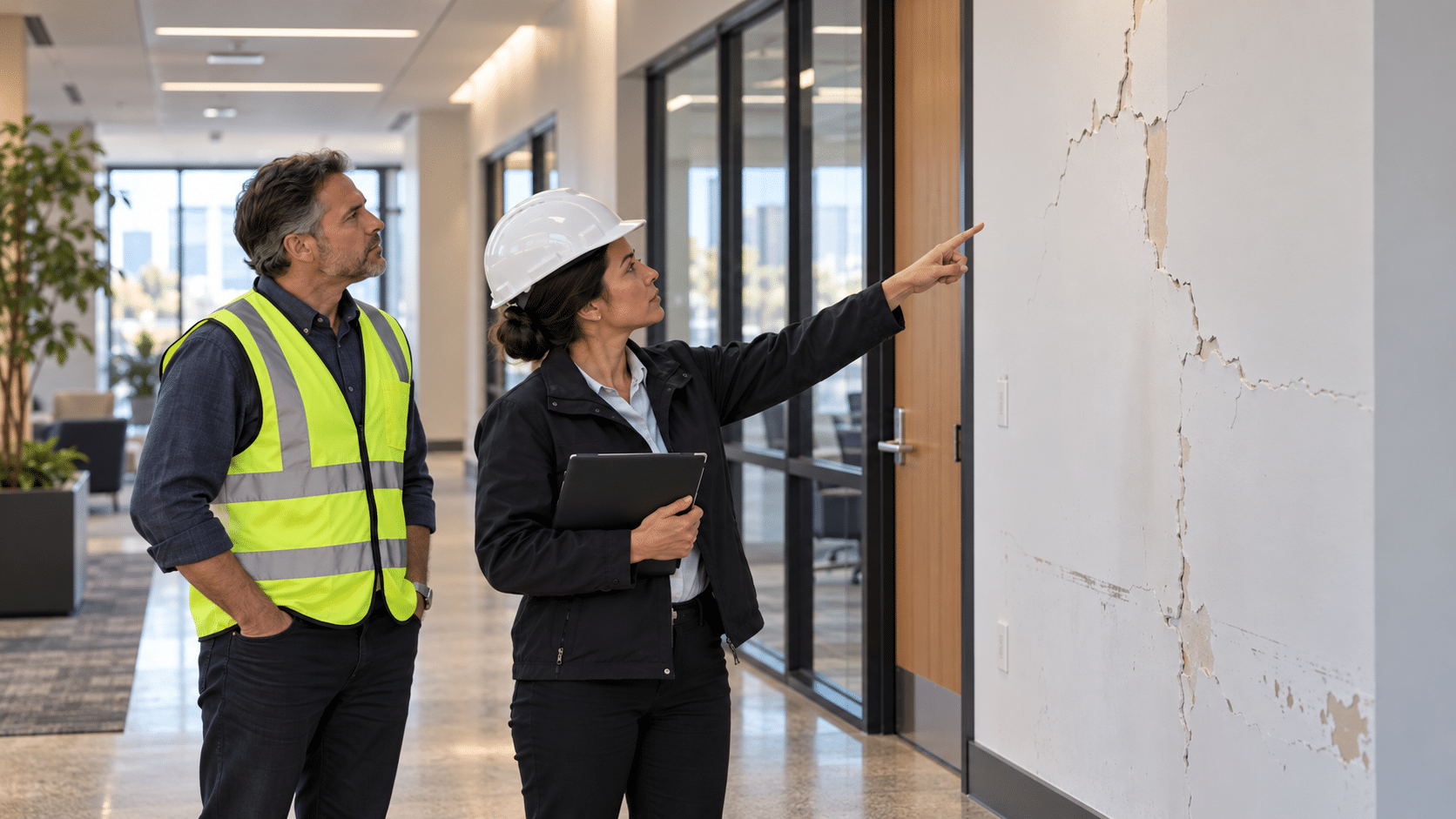
Organizations evaluating their earthquake response plans often ask us two questions: first, why is site-specific earthquake data necessary when regional shaking information is already available? And second, why can’t on-site staff simply perform a quick visual assessment after an earthquake?
We addressed the first question in our previous post: Understanding Regional and Site-Specific Earthquake Impact Data: Different Tools for Different Use Cases.
Regional data is valuable for understanding the general extent of an earthquake and where stronger shaking may have occurred. But when employee safety, critical assets, and business continuity are at stake, organizations need more specific information to make timely and informed decisions.
The second question is equally important. Staff at the site can play a valuable role after an earthquake, but relying on untrained employees or contractors to make structural safety or business continuity decisions can introduce significant risk.
Where Internal Assessments Can Fall Short
Consider an organization with multiple facilities across an earthquake-prone region. Its portfolio may include production sites, warehouses, offices, retail locations, healthcare facilities, utility assets, or logistics hubs.
Each facility has its unique structural vulnerabilities, which pose simultaneous threats to occupant safety and operational continuity.
Many organizations prepare by training facility personnel (internal staff or contracted security staff) to identify and report visible signs of damage to an emergency management team. That is a necessary, but not sufficient, part of earthquake preparedness.
Risks compound when those cursory observations become the primary basis for deciding whether a building is safe, if employees can return, or when operations should continue.
Damage Observation vs Damage Interpretation
A company performing its own post-earthquake site inspections is implicitly making a few crucial assumptions, including (but not limited to):
- Availability of staff to perform inspections
- Capability of staff to accurately flag meaningful damage
- Timely and comprehensive reporting, consolidation, and interpretation of ground truth
We’ll tackle the operational challenges of the first and third assumptions in a future blog post, but address staff capability here, as it is the easiest to take for granted.
On-site staff can and should be trained to identify obvious damage, document conditions, and communicate what they see. But observing damage and interpreting it are two different things. Without rigorous structural engineering experience it is easy to overlook less obvious damage. This isn’t about gatekeeping; damage to structural connections, framing systems, equipment anchorage, mechanical systems, or components concealed behind walls and ceilings can be quite tricky to spot and interpret. Aesthetically, a facility may appear undamaged yet be at risk of structural failure. Overlooking such hidden yet potentially severe damage can prove disastrous during aftershocks – leading to potential safety and liability risks.
Conversely, minimally trained inspectors can also overestimate damage. It is quite common in emergency management for cosmetic damage to trigger facility closures despite no true threat to safety or operational continuity. This overly cautious approach can (and often does) lead to immediate and downstream impacts to product/service delivery and unnecessary financial losses.
Yet, while an engineer can’t guarantee safety, a trained structural engineer can put any visible damage in its proper context. For example, an engineer might recognize that a handful of drywall cracks does not point to a more serious loss of building strength. A lay inspector may see similarly innocuous damage and err on the side of caution by prompting facility closures, leading to unnecessary and costly downtime and uncertainty.
Structural Engineers Bring the Expertise These Decisions Require
Post-earthquake building assessments are not simply about identifying cracks, fallen ceiling tiles, or other visible signs of damage. Structural engineers are trained to understand how buildings respond to earthquake shaking and to spot seemingly innocuous conditions that belie a more serious safety issue. They can evaluate damage in the context of a building’s structural system, age, and known vulnerabilities. By comparing site-specific shaking measurements with the initial design specifications of the building, structural engineers can also flag potential hidden damage.
This technical expertise simply can’t be replaced with cursory on-site inspections by lay staff. For crucial decisions regarding occupant safety, reentry, structural condition, and continued operations, that distinction matters.
Structural Engineering Support Should Be Part of the Plan Before an Earthquake
For organizations with large property portfolios, waiting until an earthquake hits to hire structural engineering support is too late. Establishing a relationship with a structural engineering firm in advance is an important step in emergency preparedness and business continuity planning.
A structural engineering firm on retainer will proactively become familiar with an organization’s facilities before an earthquake occurs. This enables the firm to highlight buildings with seismic vulnerabilities and prioritize a post-earthquake facility inspection gameplan. When formalized, this approach can also establish a client-specific Accelerated Building Reoccupancy (ABR) Program (or Building Occupancy Resumption Program), setting procedures for facility inspections and ultimately reoccupancy after an earthquake occurs.
This preparation also helps clarify roles. Internal teams can then focus on reporting obvious damage and following emergency procedures, while qualified engineers are responsible for interpreting structural conditions and providing the technical guidance needed to support critical reoccupancy and operational decisions.
Without that planning, organizations may find themselves trying to secure engineering resources at the same time many other building owners are doing the same.